Sharper Mind, Harder Fighter: What Muay Thai Actually Does to Your Brain

You've probably noticed it. A few months into consistent Muay Thai training, something shifts. You're faster to read a room. You make decisions at work without second-guessing yourself into paralysis. You stay calm when someone cuts you off on the freeway instead of going full road-rage mode. Your training partners notice it too. There's a reason fighters often describe the gym as the clearest their heads ever feel — and it's not just the endorphins.
Sports scientists and neurologists have been quietly building a case for years: combat sports training, and Muay Thai specifically, triggers measurable, lasting changes in how your brain processes information. This isn't motivational poster stuff. This is peer-reviewed, scan-the-actual-brain science. Let's break it down.
Your Brain on the Bag: Neuroplasticity in Action
Neuroplasticity is the brain's ability to reorganize itself by forming new neural connections throughout life. For a long time, scientists believed this capacity basically dried up after childhood. We now know that's wrong — and physical training, especially complex motor skill training, is one of the most powerful neuroplasticity triggers available to adults.
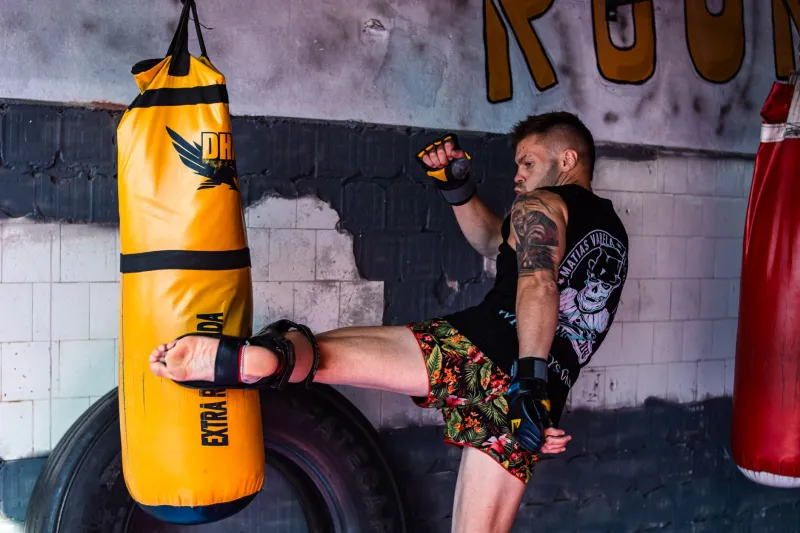
Muay Thai is almost uniquely demanding in this regard. Unlike running or lifting, where movement patterns are relatively fixed and repetitive, striking arts require you to constantly process incoming information — your opponent's posture, their rhythm, the angle of their hips — and produce coordinated, precise outputs in fractions of a second. Research published in journals like Frontiers in Human Neuroscience has shown that this kind of complex motor learning drives significant growth in the cerebellum and prefrontal cortex, two regions critical for coordination, planning, and impulse control.
Every time you drill a teep counter or practice reading a jab-cross combination in sparring, you're literally reshaping your neural architecture. The forge metaphor isn't just branding — your brain is genuinely being hammered into a different shape.
Reaction Time Is a Trainable Skill (and It Transfers)
One of the most measurable cognitive gains from Muay Thai is reaction time improvement. A 2020 study examining combat sports athletes found that experienced fighters demonstrated significantly faster simple and choice reaction times compared to non-athletes — not just in physical tasks, but in cognitive ones too.
Here's why that matters for everyday life: reaction time isn't purely physical. It's a measure of how quickly your nervous system can detect a stimulus, process it, and initiate a response. When you spend months training yourself to slip a punch or cut off the angle on a roundhouse, you're not just building faster hands and feet. You're training your entire threat-detection and response system to operate more efficiently.
American fighters who've been at it for a year or two often report this without even connecting it to their training — they catch things faster, they notice details they used to miss, they respond to unexpected situations without freezing. That's your combat-trained nervous system doing its job off the mat.
The Prefrontal Cortex and the Art of Not Panicking
Here's where it gets really interesting. The prefrontal cortex (PFC) is the part of your brain responsible for executive function: decision-making, emotional regulation, planning, and impulse control. It's also the part that tends to go offline when you're under serious stress — a phenomenon sometimes called "amygdala hijack," where your fight-or-flight response essentially shuts down rational thought.
Sparring is, neurologically speaking, a controlled stress inoculation. Every round of live work forces you to keep your PFC online under pressure. You have to think — pick your shots, manage distance, adapt your game plan — even while your body is screaming that it wants to either panic or throw wild haymakers. Over time, this trains your brain to maintain executive function under stress more effectively.
Research on military personnel and first responders has documented similar effects from high-stress scenario training. The principle is the same: repeated, controlled exposure to pressure builds the neural pathways that keep you sharp when things go sideways. For American fighters juggling demanding jobs, families, and training schedules, this cognitive resilience pays dividends everywhere.
Spatial Awareness: The Hidden Cognitive Upgrade
Muay Thai is a full-body spatial puzzle. You're constantly calculating distance, angles, timing, and positioning — and doing it simultaneously for yourself and your opponent. This kind of three-dimensional spatial processing is handled primarily by the parietal lobe, and studies on combat sports athletes show measurable advantages in spatial reasoning tasks compared to control groups.
What does better spatial awareness look like in real life? Improved driving, better athletic performance in other sports, enhanced ability to navigate complex environments, and — perhaps most practically — stronger situational awareness in social settings. You get harder to surprise, in every sense of the word.
Discipline as a Neural Habit
Beyond the flashy neuroscience, there's something simpler and equally important happening in Muay Thai gyms across the country every day: repetition building discipline as a literal brain habit.
Habit formation is governed by the basal ganglia, a set of structures deep in the brain that encode repeated behaviors into automatic routines. Every time you drag yourself to the gym when you don't feel like it, every time you drill the same combination for the hundredth time, every time you choose the hard thing over the easy one — you're strengthening the neural circuits that make disciplined behavior feel natural rather than forced.
This is why serious Muay Thai practitioners tend to report that their training bleeds into their professional and personal lives. It's not willpower. It's that their brains have been reconditioned to default toward consistency and follow-through. The gym becomes the training ground for a broader operating system upgrade.
Practical Takeaways for the American Fighter
So what do you actually do with all this? A few things worth keeping in mind:
Prioritize sparring variety. Drilling with the same partners in the same patterns limits cognitive adaptation. Rotate partners, change up the rules (elbows only, kicks only, work from the clinch), and keep your brain guessing. Novelty is the engine of neuroplasticity.
Sleep is non-negotiable. Neural consolidation — the process by which your brain actually locks in new connections — happens during deep sleep. Skimping on rest after hard training sessions isn't just bad for your body. It literally undermines the cognitive gains you worked for.
Track your mental game, not just your physical one. Keep a training journal that includes notes on decision-making in sparring, moments where you stayed calm under pressure, and situations where you froze or panicked. Reviewing this over time makes the cognitive growth visible — and that visibility reinforces the habits that drive it.
Be patient. The neuroscience research consistently shows that meaningful structural brain changes from training take months, not weeks. Trust the process. The forge doesn't work fast — it works right.
Muay Thai has always been sold on its physical results. And yeah, the conditioning is real. But the mental transformation is just as legitimate, just as measurable, and honestly just as hard-earned. Every round you put in is shaping not just your body, but the hardware running it. That's worth showing up for.