Lock, Control, Destroy: A Fighter's Guide to Dominating the Clinch Range
Walk into most American gyms and watch a sparring session. The moment two fighters tie up, one of two things happens: they push apart out of habit, or they flail around hoping for a lucky knee. Neither is Muay Thai. Not really. Not the way they train it in Bangkok, Chiang Mai, or any serious Thai camp where clinch work eats up a full third of practice time.
If you want to compete — and compete seriously — you need to treat the clinch not as a reset button but as a weapon range. This is where fights get won and lost in slow, grinding inches. Let's get into it.
Why American Fighters Undervalue the Clinch
Here's the honest truth: a lot of US-based Muay Thai training comes filtered through kickboxing traditions where the clinch gets broken up fast. Referees in some domestic promotions break fighters apart quickly, which reinforces the idea that clinching is passive. Combine that with the cultural love of flashy striking exchanges, and you've got a generation of fighters who are comfortable at long range but completely lost in the phone booth.
Watch footage of top Thai fighters — guys like Saenchai or Dieselnoi in his prime — and you'll notice the clinch is never passive for them. It's a constantly shifting chess match of grips, angles, and pressure. Every second in the clinch is either gaining control or setting something up.
Grip Placement: The Foundation of Everything
Your grip is your clinch. Get this wrong and nothing else works.
The double collar tie — both hands locked behind the opponent's neck — is the most recognizable clinch position, but it's also the most commonly misused. A lot of fighters grab high on the head and pull down, which burns out your arms fast and gives your opponent leverage to swim out.
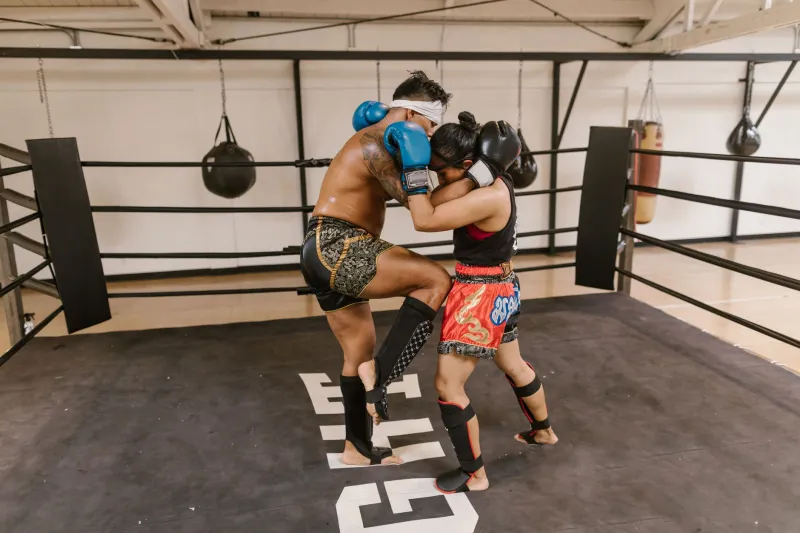
Instead, think about placement at the base of the skull. Your palms should cup the back of the head, fingers interlaced or overlapping, with your elbows driving inward toward each other. That inward elbow pressure is the actual control mechanism. It limits your opponent's ability to create space, keeps their posture broken, and sets up your offense naturally.
One grip variation worth drilling is the single collar tie with an underhook on the opposite side. This asymmetrical position is incredibly useful for off-balancing your opponent and transitioning to sweeps or body knees. Thai fighters use this constantly as a transition grip — it's not a dominant position, but it's a dynamic one.
Drill it: Spend five minutes at the end of every session doing nothing but grip battles with a partner. No knees, no sweeps. Just fight for grip position. You'll develop sensitivity to your opponent's weight shifts and grip breaks faster than any pad drill will teach you.
Balance Management: The Part Nobody Talks About
Control in the clinch isn't just about your hands — it's about your base. Thai fighters maintain a slightly wider stance than most people expect, with bent knees and weight centered over the hips. This low, rooted position makes them incredibly difficult to off-balance while keeping them mobile enough to shift angles.
Watch slow-motion footage of elite clinch exchanges and pay attention to the feet. The best fighters are constantly making small, subtle adjustments — a quarter step here, a pivot there — to maintain their base while disrupting their opponent's. It looks effortless because the footwork is so small, but it's completely intentional.
The mistake most beginners make is going stiff. When someone pushes or pulls in the clinch, the instinct is to resist directly. Instead, learn to redirect that energy. If your opponent drives forward, don't push back — pivot slightly and use their momentum to break their posture. This concept, borrowed from the Thai principle of "nua" (softness within hardness), is what makes elite clinch fighters look like they're barely trying.
Drill it: Practice the "push-pull redirect" with a partner. Have them apply steady pressure in one direction while you practice pivoting and redirecting rather than resisting. Do this for two-minute rounds. Your balance instincts will sharpen quickly.
Setting Up the Knee Strike
Here's where the setup pays off. Once you've established grip and disrupted your opponent's balance, the knee almost sets itself up — but only if you understand the mechanics.
The most effective knee strikes in the clinch come when your opponent's posture is compromised. If their head is pulled slightly forward and down, their hips naturally shift back, opening the body. That's your window. Drive the knee upward and slightly forward, not just straight up. You want to meet their body as it's moving into the strike, not just swing your leg up and hope.
Think about the "pull-and-knee" combination: use your grip to pull their head slightly downward, feel their hips shift back in response, and drive the knee into the midsection immediately. This isn't a power move — it's a timing move. Smaller fighters use this to devastating effect against bigger opponents because the leverage does the work.
For taller opponents, the long knee to the thigh or hip is a legitimate weapon that disrupts their base without requiring you to pull them down first. It's less glamorous but functionally effective.
Drill it: With a partner holding a belly pad, practice the pull-and-knee sequence ten times on each side. Focus on timing the knee to land at the moment of maximum posture break, not before or after. Record yourself if you can — the timing issue is almost always visible on video.
Putting It Together: A 20-Minute Clinch Routine
Here's a simple session structure you can drop into your existing training:
- 5 minutes — Grip battle only (no offense, just position fighting)
- 5 minutes — Positional clinch sparring with knees (light contact, focus on technique)
- 5 minutes — Sweep and off-balance drilling with a partner
- 5 minutes — Live clinch rounds at medium intensity
Do this three times a week for a month. You won't recognize your clinch game.
The Competitive Edge You're Leaving Behind
Most of your domestic competition is neglecting this range. That's not a guess — it's a pattern visible at regional tournaments across the country. The fighter who can dictate the clinch range, control the pace of exchanges, and land clean knees while staying balanced is going to win fights that look even on paper.
The clinch isn't a specialty skill reserved for Thai fighters or grapplers. It's a core Muay Thai competency, and the forge is right here in your gym. Start treating it that way.