Lifting Heavy Won't Make You Hit Harder: The Muscle-Building Mistake Costing American Fighters
Walk into any Muay Thai gym in the US and you'll probably find at least a handful of fighters who spend as much time under a barbell as they do on the pads. Big arms, thick traps, a chest that fills out a compression shirt — it all looks the part. The problem? A lot of that muscle is doing absolutely nothing for their game inside the ring. Worse, it might be actively getting in the way.
This isn't a knock on strength training. It's a reality check on how American fighters are approaching it — and why the conventional bodybuilding mindset is one of the sneakiest performance killers in the sport.
The American Weight Room Obsession
There's a deeply embedded cultural bias in US fitness culture that equates size with power. We grew up watching football players, action movie heroes, and CrossFit athletes celebrate mass as a marker of toughness. That narrative bleeds directly into combat sports training, where too many fighters assume that a bigger muscle is automatically a more explosive one.
It's not.
Maximal strength — the kind you build grinding through heavy sets of squats, deadlifts, and bench press — is genuinely useful in certain contexts. Wrestlers and grapplers, for instance, benefit enormously from raw force production in the clinch. But Muay Thai is a striking art that lives and dies on speed, timing, and the rapid transfer of energy through the kinetic chain. Those qualities don't come from a 400-pound back squat. They come from something else entirely.
What Actually Generates Striking Power
Here's where the science gets interesting — and a little counterintuitive.
The hardest hitters in Muay Thai aren't necessarily the biggest or the strongest. They're the most elastic. Power in striking is generated through something called the stretch-shortening cycle (SSC), which is essentially your body's ability to rapidly load and release energy through tendons and connective tissue, like a rubber band snapping back into place.
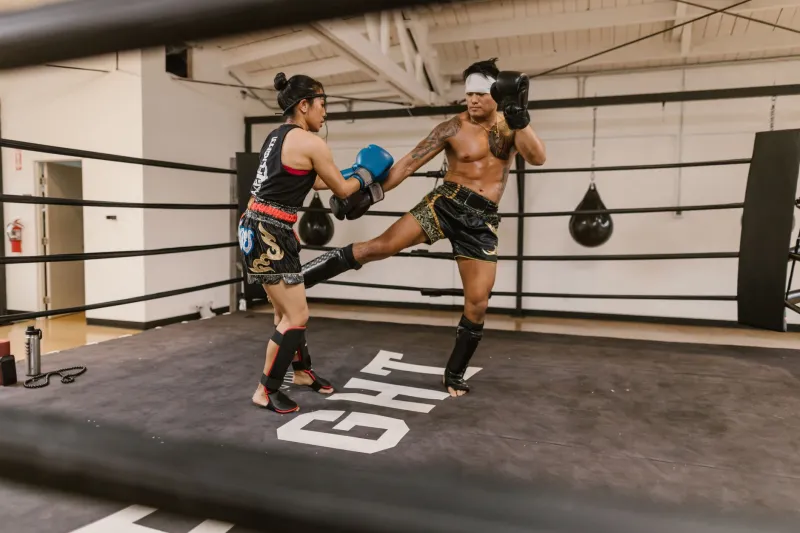
When a seasoned Thai fighter throws a teep or a rear round kick, they're not grinding through the movement with brute muscular force. They're using hip rotation, core tension, and the elastic rebound of loaded muscles to whip through the strike in a fraction of a second. The speed itself multiplies the force. That's physics — force equals mass times acceleration, and in striking, acceleration is the variable you actually want to be chasing.
Bulking up with traditional hypertrophy training increases mass, sure. But it often does so at the cost of the neuromuscular efficiency and joint mobility that make fast, fluid striking possible. You end up with a heavier, slower machine when what you needed was a sharper, quicker one.
The Endurance Equation Nobody Talks About
There's another layer here that gets overlooked constantly: explosive endurance.
A single explosive kick isn't hard to produce. The real challenge is throwing that same kick with the same snap in round three as you did in round one. That quality — the ability to sustain explosive output over time — is called explosive endurance, and it's trained completely differently than maximal strength.
Traditional strength programming typically involves heavy loads, long rest periods, and low rep counts. That's fine for building a bigger muscle. It does almost nothing to train your body to repeat explosive efforts under fatigue. Fighters who lean too hard into that style of training often notice they look great in the first round and fall apart by the third. The gas tank just isn't built for the demands of the sport.
Explosive endurance is developed through methods like plyometrics, medicine ball work, tempo-based resistance training, and sport-specific circuits that mimic the intermittent intensity of a real fight. None of that looks particularly impressive on Instagram. But it's the stuff that actually keeps your strikes sharp when your lungs are burning.
What a Smarter Training Protocol Actually Looks Like
This doesn't mean you should ditch the weight room. It means you need to use it differently.
Prioritize power over strength. Olympic lifting variations — hang cleans, power snatches, jump squats — train your nervous system to produce force quickly rather than just produce a lot of it. These movements directly translate to the hip drive and rotational speed that make kicks devastating.
Use plyometrics as a foundation. Box jumps, bounding, med ball rotational throws, and depth jumps all train the stretch-shortening cycle. If you're not doing some version of this, you're leaving elastic power on the table.
Keep rep ranges and loads appropriate. For power development, you generally want moderate loads (around 40–70% of your one-rep max) moved as fast as possible. Grinding through maximal loads trains a completely different quality.
Protect your mobility at all costs. Tight hips and stiff thoracic spines are the enemy of good technique. Heavy barbell work done without proper mobility maintenance will slowly erode the range of motion you need to throw a clean round kick or a fluid teep. Stretch. Foam roll. Do your hip work.
Structure your week intelligently. Strength and power sessions should complement your technical work, not compete with it. Showing up to a pad session with legs that are wrecked from yesterday's leg day isn't dedication — it's just bad planning.
The Mindset Shift That Changes Everything
The hardest part of this conversation isn't understanding the science. It's convincing fighters to let go of a deeply held belief that bigger equals better. American gym culture has spent decades reinforcing that idea, and it takes real intellectual humility to look at your training and ask whether the gains you're chasing are actually serving your performance.
The best Muay Thai fighters in the world — Thai legends, K-1 champions, elite American competitors who've made noise on the international stage — tend to be lean, fast, and devastatingly efficient. They look like athletes built for speed and endurance, not bodybuilders. That's not a coincidence.
If you want to hit harder, move faster, and last longer in the ring, the answer isn't more weight on the bar. It's smarter, more intentional training that respects the actual physical demands of the sport.
The forge doesn't just make things bigger. It makes them sharper. Keep that in mind next time you're tempted to load another plate.