Square Up or Get Left Behind: What Boxing Footwork Gets Dead Wrong in Muay Thai
Walk into any Muay Thai gym in America and you can spot the crossover boxers within the first five minutes of a pad session. They're the ones throwing clean, snappy punches — and then instinctively pivoting and circling when a kick comes their way, like their legs are still operating on a completely different operating system than the rest of the class.
That's not an insult. That's just physics meeting muscle memory.
The transition from Western boxing to Muay Thai is one of the most common journeys in American combat sports right now. And almost universally, coaches will tell you the same thing: the hands come along quickly. The feet take forever.
The Bladed Stance Problem
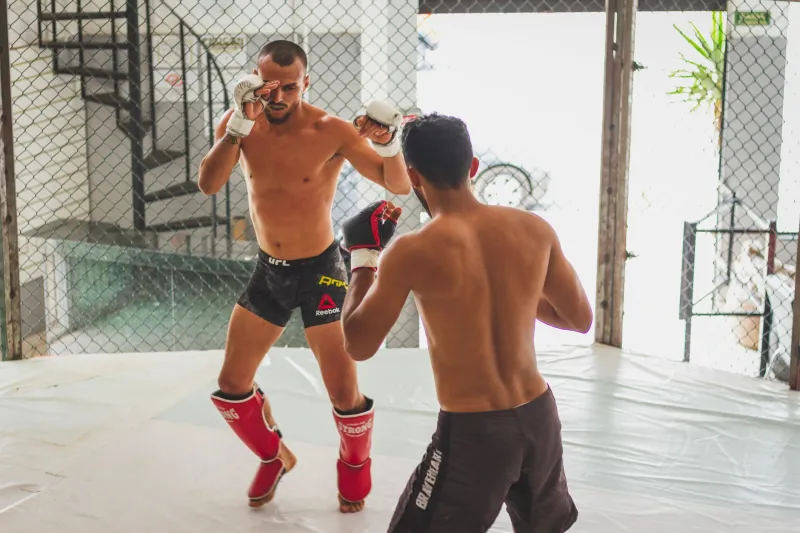
In traditional boxing, fighters stand at roughly a 45-degree angle to their opponent. The lead shoulder is forward, the chin is tucked, and the body is rotated to minimize target surface area. It's a design optimized for one thing: surviving and delivering punches in a sport where punches are the only weapon.
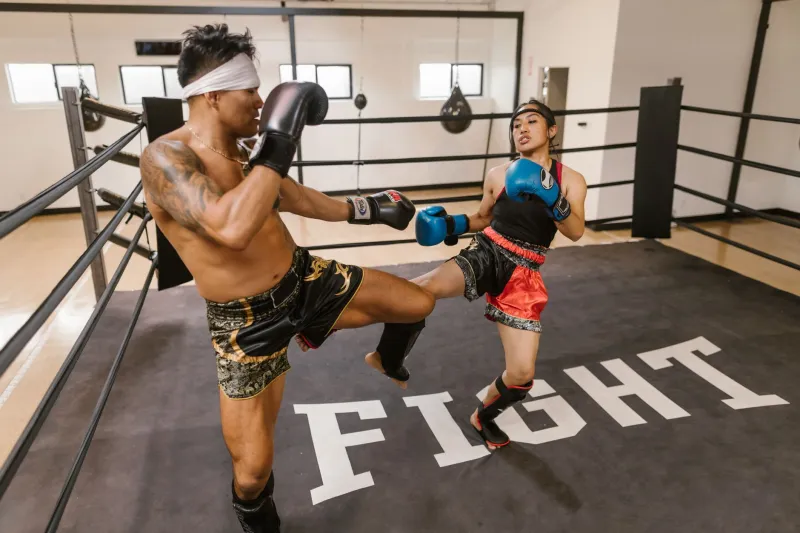
Muay Thai doesn't have that luxury — or rather, that limitation. With kicks, knees, elbows, and the clinch all in play, a bladed stance creates specific vulnerabilities that experienced Thai fighters will exploit mercilessly. A low kick to the lead leg is exponentially more damaging when that leg is load-bearing and forward. A teep to the hip sends a bladed fighter stumbling sideways. And getting pulled into the clinch while squared at 45 degrees is a fast track to eating a knee you never saw coming.
The squared-up Muay Thai stance — hips more parallel to the opponent, weight distributed evenly, guard slightly wider — exists for a reason. It's not sloppy. It's comprehensive.
But try telling that to someone who's spent three years drilling the exact opposite.
The Mental Block Is Real
Coach Danny Ruiz, who runs a Muay Thai program out of Phoenix and has worked with several boxing-to-Muay Thai converts, puts it bluntly: "The hardest part isn't physical. The hardest part is convincing a guy who's been told his whole boxing career that squaring up gets you hurt. Now I'm asking him to square up — and trust it."
That psychological rewiring is genuinely difficult. Experienced combat athletes have a deep, almost subconscious relationship with their defensive instincts. When someone throws a punch, a trained boxer doesn't think about moving — they just move. Dismantling those automatic responses and rebuilding them around a different framework takes months of deliberate, uncomfortable drilling.
Marcus Webb, a 28-year-old amateur fighter from Atlanta who spent four years boxing before switching to Muay Thai, described his first six months as "embarrassing in the best way possible." He said, "I kept slipping punches like I was still in a boxing gym. My sparring partners would just walk me down and knee me because I was giving them my hip every time I tried to move. I had to basically start over from zero with my footwork."
The Drills That Actually Bridge the Gap
So what actually works when retraining lower body mechanics for eight-point striking? Coaches who specialize in these conversions tend to rely on a handful of specific approaches.
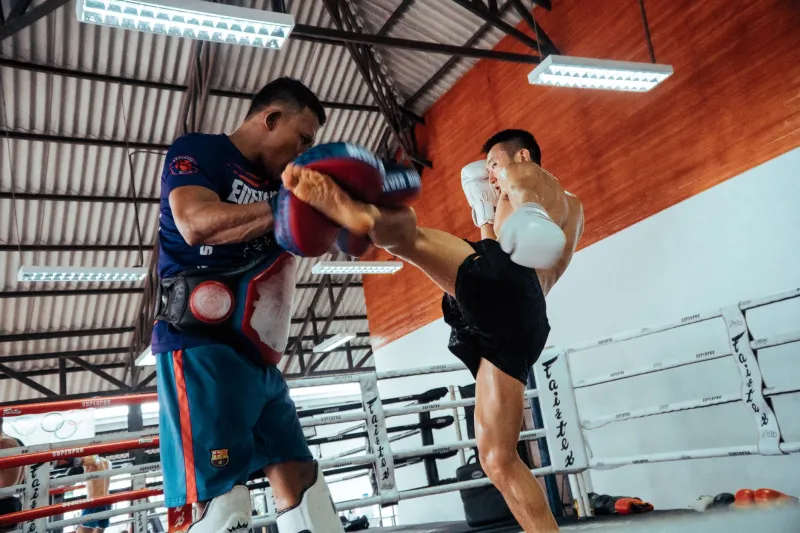
Teep defense and positioning drills are a go-to starting point. Because the teep (push kick) is so central to range management in Muay Thai, forcing a boxer to deal with it consistently — without being able to simply angle off like they would from a jab — creates an immediate, undeniable lesson in why stance matters. You can't circle away from a teep the same way you circle from a straight punch. The body learns this fast when the alternative is eating a foot to the stomach.
Switch-stance shadowboxing is another tool coaches use to break the habitual lean toward boxing posture. By regularly practicing from the opposite stance, fighters interrupt the autopilot that keeps pulling them back to their boxing roots. It's disorienting at first, but it builds stance-neutral body awareness.
Clinch entry drills paired with footwork address a gap that pure boxing training never touches. When a Muay Thai fighter closes distance and initiates a clinch, a boxer's instinct is often to create space and reset — exactly what you'd do in boxing. Drilling the clinch transition repeatedly, from the squared stance, teaches fighters that close range isn't a problem to escape; it's a different kind of opportunity.
Finally, low kick defense integrated into pad work is essential. Many boxing-to-Muay Thai conversions neglect this because pad work in boxing doesn't include it. Building low kick checks into standard combinations forces the fighter to think about their base positioning constantly, not just when a kick is obviously incoming.
Why This Adjustment Hits Harder Than Expected
There's a particular frustration that experienced athletes feel when they're asked to regress. A boxer who's competed, who's earned their skill set, who's won rounds — that person has an identity tied to their craft. Being told that their footwork is wrong, or at least incomplete, lands differently than it does for a complete beginner.
Coach Ruiz sees it regularly. "The beginners just absorb it. They don't have anything to unlearn. But a guy who's been competing for years? He's got ego wrapped up in his movement. And that ego, even if it's subtle, slows down the learning."
The fighters who make the transition smoothly tend to be the ones who approach Muay Thai with genuine beginner's mind — who can hold their boxing skill in one hand and their Muay Thai development in the other without letting the first one contaminate the second.
Marcus Webb says the shift finally clicked during a sparring session about eight months into his transition. "I stopped trying to box with Muay Thai rules and just started doing Muay Thai. It's a different sport. Once I accepted that, my feet figured themselves out."
The Payoff Is Worth the Pain
Here's the thing nobody tells crossover athletes enough: once the footwork clicks, former boxers often become exceptionally dangerous Muay Thai fighters. The hand speed, the punch timing, the defensive head movement — all of that transfers. It just needs the right foundation underneath it.
The squared stance isn't a limitation. It's a platform. And once a boxer stops fighting it, they usually realize they've been standing on top of a completely different game this whole time — one with eight weapons instead of two, and room to grow they never knew existed.
The feet just have to catch up first.