Borrowed Skills, Real Power: How Cross-Trained Athletes Are Reshaping American Muay Thai
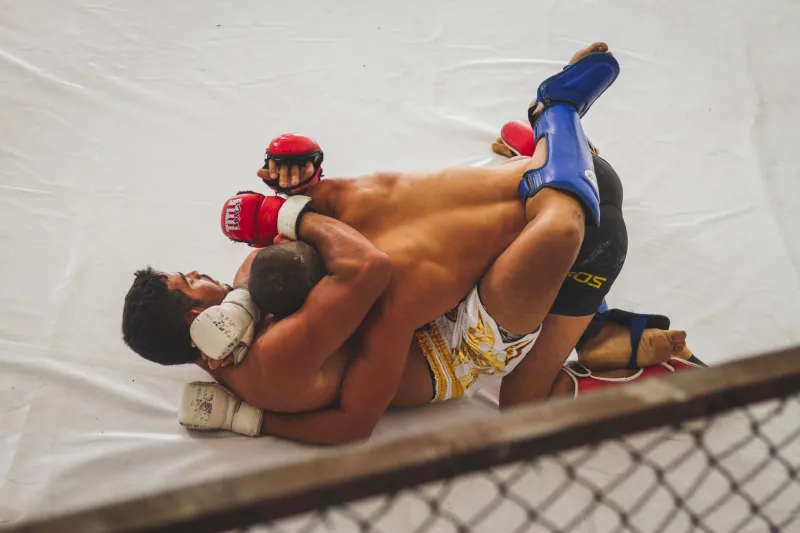
There's a guy at a gym in Denver — former high school wrestler, picked up Muay Thai at 24 — who's been competing for about three years. He doesn't have the most polished teep. His elbow technique still needs work. But the moment he ties up in the clinch, something shifts. His base drops, his hips engage, and suddenly he's controlling a more experienced opponent like it's nothing. His coach just grins. "The wrestling never really leaves," he says.
This scene is playing out across America, and it's quietly changing what competitive Muay Thai looks like at every level. Fighters arriving with wrestling backgrounds, boxing fundamentals, or years of Brazilian Jiu-Jitsu are bringing toolkits that interact with Muay Thai in fascinating, sometimes disruptive ways. The sport is absorbing these influences and evolving — and the fighters who understand what's happening are the ones getting ahead.
The Wrestler's Edge: Base, Clinch, and Pressure
If there's one cross-training background that translates most immediately and visibly into Muay Thai, it's wrestling. The overlap is almost uncomfortable in how obvious it becomes once you see it.
Muay Thai's clinch — the inside fighting range where knees, elbows, and throws become available — is a domain that wrestlers enter with an almost unfair advantage. Years spent learning to control another person's body, to feel and counter weight shifts, to maintain a low center of gravity under pressure — all of that transfers directly.
Jordan Callahan, a former Division II college wrestler who transitioned to Muay Thai in his mid-twenties, describes the adjustment this way: "The clinch in Muay Thai is obviously different from a wrestling tie-up, but the underlying principles are the same. I already understood frames, underhooks, and body positioning. I just had to learn where the knees go and how to use the neck tie."
What wrestlers also bring is an attitude toward pressure and forward movement that can be genuinely difficult for traditionally trained Muay Thai fighters to handle. A wrestler-turned-nak muay who's learned to throw leg kicks and elbows while maintaining constant forward pressure represents a tactical problem that pure technical striking doesn't always solve.
The adjustment wrestlers typically need to make is learning to stay composed and effective at longer range — where Muay Thai lives much of the time — and developing comfort with the standing, upright guard position rather than the lower, more crouched wrestling stance. It takes time, but the foundation accelerates everything else.
The Boxer's Gift: Timing, Defense, and Combination Flow
Boxers who come to Muay Thai bring a different kind of advantage — one that shows up in subtler ways but runs deep.
Hand speed, punch accuracy, head movement, and the ability to read distance are all refined by years of boxing training in ways that general Muay Thai training doesn't always prioritize. A fighter who's spent three years in a boxing gym understands rhythm at a level that takes most strikers much longer to develop. They know when to pull the trigger, when to slip, and how to chain punches together without losing structure.
The challenge for boxers is the opposite of the wrestler's problem: range management and the expanded threat landscape. In boxing, you only have to worry about punches. In Muay Thai, kicks — especially leg kicks and body kicks — completely change how you move and position. Former boxers often struggle initially with keeping their hands too low, dropping their guard to throw punches, and not checking leg kicks instinctively.
But once those gaps get addressed, the boxing background often produces fighters with exceptional combination flow and defensive timing. "The guys who come from boxing tend to be really hard to hit cleanly," notes Marcus Webb, a Muay Thai coach based in Chicago who's trained fighters from multiple combat sports backgrounds. "They have a feel for distance and timing that you can't fake. Once they start respecting the kicks, they level up fast."
The Grappler's Lens: Angles, Setups, and Transitional Thinking
Brazilian Jiu-Jitsu and submission grappling backgrounds offer something less obvious but arguably just as valuable: a deeply ingrained ability to think in sequences and set up techniques through positioning rather than power.
Grapplers are trained to think several moves ahead — to recognize that a submission isn't just a submission, it's the end of a chain that started three exchanges earlier. When that mindset gets applied to Muay Thai, it produces fighters who use feints and footwork in unusually sophisticated ways, creating openings rather than just throwing and hoping.
The clinch is another area where grapplers find immediate applicability. While their clinch instincts are oriented toward takedowns rather than knees and throws, the body awareness and leverage understanding transfer meaningfully. A BJJ practitioner who's learned to read another person's balance and weight distribution can adapt that sensitivity to Muay Thai's clinch mechanics relatively quickly.
What grapplers often need to develop from scratch is the willingness to stand and exchange — the comfort with taking shots while delivering them, and the confidence to work at striking range without defaulting to a takedown attempt. That mental shift can take time.
What This Means for Traditional Muay Thai Athletes
Here's the uncomfortable question: do pure Muay Thai fighters — those who came up training nothing but the art — need to adapt to keep pace?
The honest answer is probably yes, at least at the competitive level. Not because traditional Muay Thai is insufficient, but because the competitive landscape in the US has changed. Opponents are increasingly bringing diverse skill sets, and a fighter who's never grappled, never boxed in a boxing gym, and never wrestled may have gaps that get exposed by someone who has.
The good news is that cross-training doesn't have to mean abandoning Muay Thai fundamentals. It means adding context to them. A Muay Thai fighter who spends six months in a wrestling room doesn't need to become a wrestler — they need to understand how wrestlers move and think so they can neutralize those strengths and exploit the gaps.
Many of the most successful American Muay Thai fighters right now are doing exactly this. They're not abandoning the art. They're pressure-testing it against other disciplines and coming back with a stronger, more complete game.
The Bigger Picture
The cross-training wave isn't a threat to Muay Thai — it's a conversation the sport is having with itself about what it means to compete in the modern era. The fighters walking into gyms with wrestling shoes in their bags and boxing wraps in their pockets aren't diluting the art. They're expanding it.
And the gyms that embrace this — that welcome wrestlers into the clinch, that let boxers sharpen the striking, that let grapplers bring their sequencing intelligence to pad work — those are the gyms producing the most complete fighters right now.
The forge doesn't care where the metal came from. It only cares what gets made in the fire.